
Rider Thermal Management Innovation Proposal

The missing half of thermal management.

Mosko already keeps riders warm when temperatures drop. The next opportunity is to engineer the other side of the equation: meaningful cooling for slow technical riding, desert heat, protective layers and long adventure days.

Building on: our current heated-apparel collaborationFocus: ADV · Dual-Sport · Hot-weather riding
Year-round rider comfort12 MONTH PLATFORM
Winter

Add Heat

12V heated apparel extends the riding season and protects comfort on cold starts, high passes and long pavement stretches.

Existing Mosko strengthEctotherm
Summer

Remove Heat

Active and lightweight cooling can extend the same thermal-management philosophy into hot, slow, exposed and high-effort riding.

Next product opportunityCooling Platform

Hot-weather comfort is more than ventilation.

Motorcycle PPE protects the rider, but in hot conditions it can also restrict heat dissipation. That creates a real design tension: keep protection high without letting thermal load become the next limiting factor.

35°C

Protective gear becomes a thermal problem

Published rider studies have shown substantial heat strain while wearing motorcycle PPE in simulated summer conditions.

+2°C

Core temperature rise in a 90-min study

In one controlled 35°C trial, core temperature increased by about 2°C while riders wore protective gear.

8%

Reaction-time fluctuation

The same study reported reaction-time changes alongside higher thermal strain, workload and reduced alertness.

The product gap is not “another ventilated jacket.” It is cooling when airflow can’t.

The market is already educated —
but active cooling is still early.

Riders already buy cooling gear, and major motorcycle brands have validated the category. The open space is a premium ADV system that goes beyond simple evaporation.

$13.2BGlobal motorbike riding gear market, 2024Grand View Research
$18.1BProjected global riding gear market, 20305.5% CAGR, 2025–2030
6.0%Forecast CAGR for riding clothingFastest-growing product segment
Brand / ProductTechnologyCurrent Price SignalWhat It ProvesGap for Mosko
Alpinestars Cooling VestEvaporativeUS$219.95Premium riders already pay for cooling apparelPassive / airflow dependent
Gerbing 7V Circulatory VestWater circulationUS$399.99Active liquid cooling has retail acceptanceNot ADV-system-led
AlphaCool 12V Motorcycle SystemBike-powered circulationUS$499.9912V motorcycle cooling can support premium pricingBulky 6L cooler architecture
Mosko opportunityHybridCool + Peltier/WaterPremium ADV tierCombine rider-specific apparel, 12V know-how and pack integrationDefine the category

Why Mosko is unusually well positioned.

The opportunity is stronger for Mosko than for a generic apparel brand because the supporting ecosystem already exists.

Opportunity 01

Extend Ectotherm into year-round thermal management

Mosko already uses 12V motorcycle power in heated apparel. Cooling becomes the logical summer counterpart.

Opportunity 02

Solve the low-speed ADV gap

Ventilation performs best with airflow. Technical terrain, sand, traffic and slow climbing are exactly where rider effort rises while airflow falls.

Opportunity 03

Use Mosko’s hydration / pack expertise

Wildcat already carries a 3L Hydrapak reservoir. That creates a natural design language for a separate cooling reservoir or module.

Opportunity 04

Build under-armor cooling

Graph base layers already focus on thermoregulation and low-profile wear. HybridCool can extend that philosophy into actual water-activated cooling.

Opportunity 05

Create a premium technical story

Active cooling is harder to commoditize than ordinary mesh or evaporative products and fits Mosko’s high-function ADV positioning.

Opportunity 06

Own a category before it matures

Consumer need is proven, passive cooling is mature, but there is still no dominant premium ADV active-cooling platform.

Two products. Two very different jobs.

The goal is not to force one cooling technology across every ride. HybridCool and Peltier + Water should sit at different ends of the product ladder.

Project A · Fastest to Market

Mosko HybridCool ADV Layer

A lightweight, water-activated cooling platform designed for close-to-body wear under armor. No electronics, no ice and very little behavioral change for the rider.

ActivateAdd water
WearLow-profile under armor
RefreshRe-water as needed
PowerNo battery
Cooling characterLightweight / broad-area
Target formBase layer · vest · neck / torso zones
Best useTouring · travel · hot dry ADV
Commercial roleAccessible premium
Project B · Flagship Innovation

Peltier + Water Active Cooling

Peltier creates the cold source; water circulation distributes that cooling over a larger body area. The goal is stable, body-mapped cooling under protective riding gear.

Create ColdPeltier heat pump
DistributeWater loop
IntegrateBike / pack system
Cooling characterActive · stable · controllable
Power architecture12V bike + optional battery study
Target zonesChest · back · kidney · neck
Best useSlow ADV · desert · extreme heat
Commercial roleFlagship premium system

Current prototype evidence:
stable multi-zone cooling.

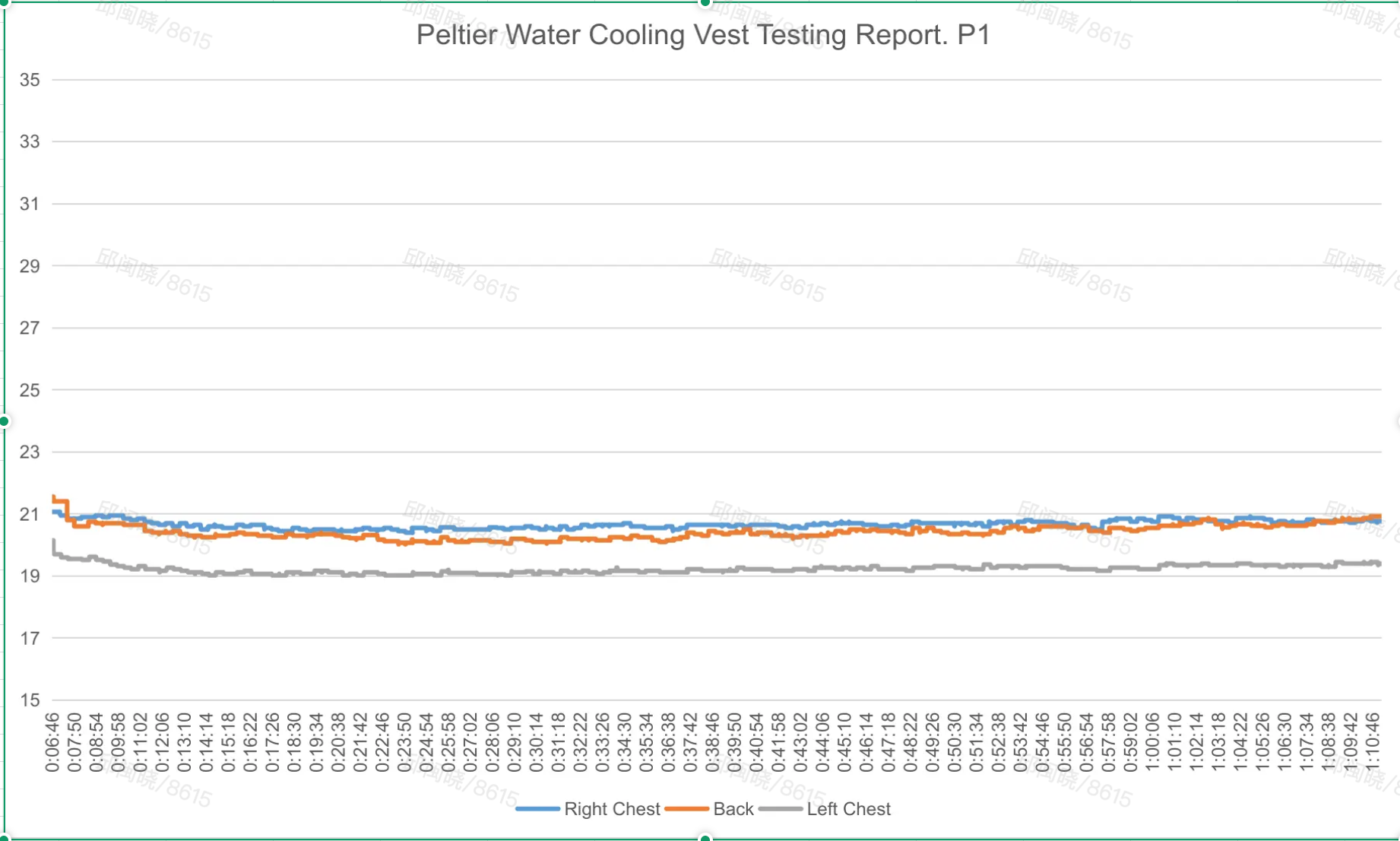
The current bench test is most interesting for its stability. Rather than a short cold peak followed by rapid decay, the monitored garment zones remained in a narrow temperature band over the test period.

Peltier Water Cooling Vest Testing Report
Current Peltier / water-circulation vest test. Right chest, back and left chest temperature traces shown over approximately 70 minutes.

What this test suggests

From the current test chart, the three monitored zones remain approximately within the 19–21°C range for more than one hour, with the left-chest zone holding close to ~19°C.

~19–21°CObserved garment-zone temperature range
60+ minStable cooling shown in current test window
3 zonesRight chest · back · left chest
Low decayRelatively flat temperature curves
Engineering note: this is promising prototype evidence, not yet a final product claim. The next Mosko-relevant test should add ambient temperature, RH, airflow, power draw, inlet/outlet water temperature, control garment and rider / mannequin conditions.

Mosko already has the pieces
to make this a real system.

This is where the concept becomes more than a vest. Mosko’s existing product architecture can help turn cooling into a rider ecosystem.

12V experience is already proven

Ectotherm uses a 12V motorcycle-powered, 42W heating architecture.
Mosko riders already accept powered apparel and bike connectivity.
The summer story can mirror winter: add heat when cold, remove heat when hot.

Pack integration is a real advantage

Wildcat 12L already integrates a 3L Hydrapak reservoir and is designed around ADV ergonomics.
A separate cooling loop could use the same pack-design expertise without sharing drinking water.
The opportunity is a complete Adventure Cooling System, not a generic vest.
12V Bike Power
Peltier Module
Chilled Water Loop
Body-Mapped Vest
Pack / Bike Integration

Recommended Mosko Cooling Pilot.

The next step should not be a purchase decision. It should be a rider-specific technical comparison that tells us which architecture deserves product development.

STEP 01

Define the rider scenario

Slow technical ADV, desert travel, traffic / stop-start, or long hot touring — select one priority environment.

STEP 02

Prepare A/B samples

Compare Mosko’s current hot-weather setup with HybridCool and Peltier + Water cooling.

STEP 03

Test airflow conditions

Run low, medium and high-airflow scenarios to identify exactly where active cooling adds value.

STEP 04

Build Mosko-specific architecture

Optimize cooling zones, power, reservoir, pack integration, runtime, weight and target retail positioning.

You already keep riders warm.
Now let’s engineer how to keep them cool.

Start with two technologies, one hot-weather rider scenario and one measurable field test. The goal is to define what real ADV cooling should look like — not simply add another cooling vest to the market.

Build the Cooling Pilot →